
- Basic Electronics - Materials
- Basic Electronics - Energy Bands
- Basic Electronics - Semiconductors
- Basic Electronics - Hall Effect
- Resistors
- Basic Electronics - Resistors
- Circuit Connections in Resistors
- Non-linear Resistors
- Basic Electronics - Linear Resistors
- Basic Electronics - Fixed Resistors
- Capacitors
- Basic Electronics - Capacitors
- Circuit Connections in Capacitors
- Variable Capacitors
- Basic Electronics - Fixed Capacitors
- Polarized Capacitors
- Inductors
- Basic Electronics - Inductors
- Basic Electronics - Inductance
- Circuit Connections in Inductors
- Types of Inductors
- Basic Electronics - RF Inductors
- Transformers
- Basic Electronics - Transformers
- Types of Transformers
- Transformers based on Usage
- Transformer Efficiency
- Diodes
- Basic Electronics - Diodes
- Basic Electronics - Junction Diodes
- Special Purpose Diodes
- Optoelectronic Diodes
- Transistors
- Basic Electronics - Transistors
- Transistor Configurations
- Transistor Regions of Operation
- Transistor Load Line Analysis
- Types of Transistors
- Basic Electronics - JFET
- Basic Electronics - MOSFET
- Basic Electronics Useful Resources
- Basic Electronics - Quick Guide
- Basic Electronics - Useful Resources
- Basic Electronics - Discussion

Basic Electronics Tutorial
Electronics is a branch of engineering that deals with the study of design, working, and applications of electronic devices and circuits. Electronic devices are those whose operation is based on the flow of electrons and holes. Electronic devices are also referred to as solid-state devices or semiconductor devices.
Electronics involves the design and engineering of these semiconductor-based devices. Therefore, electronics is also termed as solid-state engineering. Electronics devices are used to perform a variety of functions like data processing, signal amplification, information transmission, controlling of electrical energy flow in circuits, and many more.
Electronics finds applications in various engineering and industrial disciplines such as communication, computer engineering, information technology, control and automation, power electronics, consumer electronics, etc.
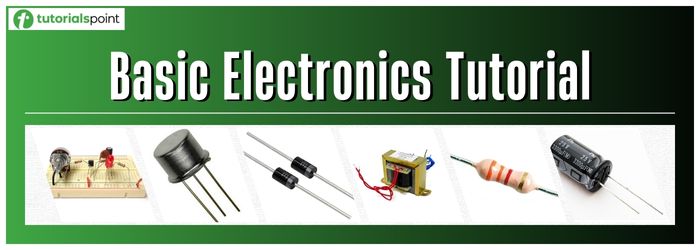
In modern society and industry, electronics is an integral part of simple household appliances to large scale communication systems and power distribution. Therefore, understanding the principles of electronics and operations of electronic devices is very important to take complete benefits of modern technologies.
Introduction to Basic Electronics
Basic Electronics is an introductory course studied in the first or second semesters in electrical and electronics engineering in undergraduate levels. The main objective of this course is to explain the fundamental concepts of electronics engineering and to understand the working and applications of various electronic components such as resistors, diodes, transistors, rectifiers, transformers, etc.
Basic electronics is the foundation for many advanced courses like analog electronics, digital electronics, power electronics, electronic drives and controllers, smart grids, electric vehicles, modern control systems, and many other.
This tutorial on Basic Electronics is divided into eight modules −
1. The first module covers the Basic Concepts related to electronics such as electronic materials, energy bands, types of semiconductor materials, and theory of hall effect.
2. The second module discusses the concepts related to resistors such as resistor definition, connections of resistors, types of resistors – linear resistor, non-linear resistor, and fixed resistors.
3. The third module describes the basics of capacitors and it covers topics like introduction to capacitors, connections of capacitors, types of capacitors – fixed capacitors, variable capacitors, and polarized capacitors.
4. The fourth module discusses the concepts related to inductors. It covers topics like introduction to inductors, theory of inductance, connections of inductors, types of inductors, and RF inductors.
5. The fifth module explains electrical transformers. It discusses about basic theory of transformers, types of transformers, classification of transformers based on usage, and efficiency of transformer.
6. The sixth module is about a basic electronic device called Diode. This module explains the basic concepts related to diodes, theory of junction diodes, special purpose diodes like Schottky diode, tunnel diode, varactor diode, etc., and optoelectronic diodes like photo diode, solar cell, etc.
7. The seventh module discusses about different types of transistors and it covers topics like basics of transistors, types of transistors, transistor configurations, transistor regions of operation, load-line analysis of transistors, basics of junction field effect transistors (JFETs), and metal oxide field effect transistors (MOSFETs).
8. The final eighth module of this tutorial provides a quick guide, useful resources, and community discussion platform on basic electronics.
The main objective of this tutorial is to present the fundamental concepts of basic electronics in an easy-to-understand and interesting manner. All chapters in this tutorial are presented in a lucid and easy to understand language, making it suitable for absolute beginners. Each concept is explained thoroughly to give students a good understanding of principles and applications of electronic components and devices.
Prerequisites to Understand Basic Electronics
Basic Electronics is an introductory course and this tutorial explains the basic concepts of electronics in a beginner friendly style. However, if you have basic understanding of elementary physics and mathematics, then you can get full benefit from this tutorial.
This tutorial on Basic Electronics has been designed in a way that undergraduate college students can use it as an introductory resource while the practicing electronics engineers can use it as a reference.
FAQs on Basic Electronics
In this section, we will answer some of the most Frequently Asked Questions (FAQs) on Basic Electronics.
1. What are the most important concepts in basic electronics?
Some of the most important concepts in basic electronics are as follows −
- Semiconductors − In the field of electronics, semiconductors are important materials used for fabricating various electronic devices and components like diodes, transistors, integrated circuits, LEDs, logic gates, etc. Semiconductors are those materials having electrical conductivity between conductors and insulators. The most commonly used semiconductors in electronics are silicon (Si) and germanium (Ge). Overall, semiconductor are fundamental building blocks of electronics.
- Resistors − These are the commonly used circuit components in electronics. Resistors are used to control the amount of electric current in electronics circuits.
- Capacitors − Capacitors are also basic circuit components in electronics used for storing electric charge and design circuits to perform signal filtering.
- Inductors − Inductors are used in electronic circuits to store energy in the form of magnetic field and filter out the alternating current signals.
- Transformers − Transformer is an electromagnetic device. It is used in electronic circuits to reduce the high voltage like 220 Volts into the lower values like 5 V, 12 V, 24 V, or any other suitable value for electronic circuits.
- Diodes − Diodes are the most basic semiconductor devices. A typical diode consists of two semiconductor regions namely, p-type and n-type, thus have a pn-junction. It is used in electronic circuits as a unidirectional device or as a static switch. One of the most common application of diodes is rectification i.e., conversion of AC into DC.
- Transistors − Transistors are three-terminal semiconductor devices used in electronics to perform two main functions namely, amplification and switching of electric signals. Transistors are the building blocks of most electronic circuits and complex devices.
Apart from these, other important concepts in electronics are voltage, current, electrons, holes (positive charges in semiconductors), power, etc.
2. How does Ohm's Law work in electronic circuits?
Ohms law is a most fundamental law in electronic circuits that describes relationship between voltage, current, and resistance in the circuit.
Mathematically, the Ohms law is given by,
$$\mathrm{V\:=\:IR}$$
Where, V is the voltage, I is the current, and R is the resistance in the circuit.
In electronic circuits, Ohms law works as follows −
- If any two qualities among V, I, and R are known, then we can calculate the third one.
- If the resistance is kept constant and the voltage is increased, the current in the circuit will also increase and vice-versa.
- If the voltage is kept constant and the resistance is increased, the current in circuit will decrease and vice-versa.
Hence, in electronics, Ohms law can be used as basic tool for designing circuits and analyze their performance for different current and voltage ratings depending on our application.
3. What is the difference between analog and digital electronics?
Analog and digital electronics are two different branches of electronics engineering. The basis of this classification is the nature of signals used.
The most fundamental difference between analog and digital electronics is that analog electronics deals with continuous-time signals, while digital electronics deals with discrete-time signals.
4. How do you calculate resistance, capacitance, and inductance in electronics?
In electronics, the calculation of resistance, capacitance, and inductance depends on the configuration of the circuits. Here are some basic formulae for calculating these three parameters in common electronic circuits.
Resistance − Resistance in a simple electronic circuit is calculated by using,
$$\mathrm{R=\frac{V}{I}}$$
Here, R is the resistance, V is the voltage, and I is the current through the conductor.
Capacitance − Capacitance in a simple electronic circuit is calculated by using,
$$\mathrm{C=\frac{Q}{V}}$$
Here, Q is the charge on each plate of the capacitor, C is the capacitance, and V is the voltage across the capacitor.
Inductance − Induction in a simple electronic circuit is calculated by using,
$$\mathrm{V=L\frac{di}{dt}}$$
Here, v is the voltage across the inductor, L is the inductance, and $\mathrm{\frac{di}{dt}}$ is the rate of change of current in the inductor.
5. What are common mistakes beginners make when learning electronics?
While learning electronics, beginners make the following common mistakes −
- They ignore basic concepts and directly jump onto complex concepts. This mistake leads confusion and lack of understanding of the subject.
- Book theory provides understanding how electronic components are made up of and how they work. But many electronics beginners avoid reading book theory and directly into practical electronics. This can lead frustration at the end.
- Avoid practicing on hands on projects and try to learn electronic circuits and their functioning through books only.
By avoiding all these mistakes, beginners can make the learning electronics enjoyable.
6. What tools do I need to start learning basic electronics?
You start your learning journey of basic electronics with the following resources −
- Introductory textbooks on basic electronics
- Beginners online tutorials and courses
- Community discussion platforms and groups
- Simulation software like Pspice, MATLAB, etc.
7. What are the different types of semiconductors in electronics?
In electronics, semiconductors are classified into the following major types −
- Intrinsic Semiconductors − These are pure semiconductors like Si and Ge.
- Extrinsic Semiconductors − These are impure or dopped semiconductors. Extrinsic semiconductors are further classified into the following two types −
- N-type semiconductors − Those extrinsic semiconductors having negative majority charges (electrons) are known as n-type semiconductors.
- P-type semiconductors − Extrinsic semiconductors having positive majority charges (holes) are known as p-type semiconductors.
8. How do transistors amplify signals in electronics?
The amplification process of electronic signals using transistors is explained below −
Step 1 − The transistor is properly biased to operate in the active region for amplification of signals. Let us consider common-emitter (CE) configuration, where the base terminal is used as input line, the emitter terminal as a common-ground for input and output, and the collector terminal as the output line.
Step 2 − A weak signal that we want to amplify is applied to the base terminal of the transistor amplifier circuit.
Step 3 − A small current flowing into the base of the transistor can cause a large current to flow out from the collector which is proportional to the base current, but much larger than that.
Step 4 − The resulting amplified output signals is received at the collector terminal, which is nothing but the amplified version of the input signal.
9. What is the role of a power supply in an electronic circuit?
In electronic circuits, a power supply performs the following functions −
- Power Conversion − Power supply takes a high-voltage (220 V or 110 V) AC supply from main circuit and converts it into a low-voltage (5 V, 12 V, 24 V, etc.) DC supply suitable for the electronic circuits.
- Voltage Regulation − Power supply also regulates the supply voltage to keep it stable.
- Protection − Power supply provides protection against overvoltage, over current, short-circuit, etc.
10. How do you troubleshoot common electronic circuit problems?
In typical electronic circuits, we can perform a systematic troubleshooting process as follows −
Step 1 − First of all, visually inspect the electronic circuit and its components for any visible damage, burn out, loose connection, broken soldering, etc.
Step 2 − If everything is found correct in the first step. Now, check power supply is properly working or not. For this, you can use a multimeter and measure the voltage at various points in the circuit.
Step 3 − If no problem is found in the power supply, next test individual components like diodes, transistors, resistors, capacitors, etc. of the circuit. If there any faulty component is found, replace it.
Step 4 − If no issues found in components, then we have to perform complex tests on the circuit using devices like oscilloscope. This process will help us to analyze the behavior of signals in the circuit.
All these steps can help us to identify and troubleshoot common problems in electronic circuits.
11. Why is circuit design important in electronics?
Circuit design is a very important step in electronic projects. The following are some common reasons behind this −
- Define correction functionality of the circuit
- Give maximum efficiency and operational performance
- Avoid circuit failures
- Improve reliability
- Optimize the resources to make the circuit cost-effective
- Reduce troubleshooting complexities, etc.
12. How are sensors used in electronic circuits?
Sensors are devices used in electronic circuits to sense or measure physical quantities like temperature, pressure, motion, etc. After measuring these quantities, sensors convert them into electric signals that can be processed using processors or controllers. Sensors are provided in electronic circuits for interfacing between process and processor.
13. What does a microcontroller do in electronics?
A microcontroller can perform the following functions in an electronic circuit −
- Data processing, calculations, and logical operations
- Controlling operations of various electronic devices
- Data acquisition from sensors
- Responding to critical operations, etc.
14. How does a breadboard help in building electronic circuits?
Breadboard is a basic tool used for building prototypes of electronic circuits. It provides a grid of interconnected holes to insert and connect different components of the circuit without the need for soldering.
In electronic circuits, the breadboard makes the assembly and modification of circuits easier. Hence, it is a best tool for simulation of electronic circuits at their prototype stage.
15. What is signal processing, and why is it important in electronics?
The process of interpreting, analyzing, and altering the electronic signals either to obtain useful information or to improve the signal quality is known as signal processing.
Signal processing is important in electronics because of the following reasons −
- To improve signal quality by reducing noise and interference.
- To increase the strength of signals.
- To perform efficient transmission and storage of signals, etc.