
- BI - Introduction
- BI - History
- BI - Main Uses
- BI - Concepts
- BI - Architecture
- BI - Types
- BI - Implementations
- BI - Applications
- BI - Examples
- BI - Phases
- BI - Teams and Roles
- BI - Financials
- IBI - Introduction

Business Intelligence Tutorial
Business intelligence is a set of tools, methods, and processes that turn raw data into useful information, helping businesses make better and more cost-effective decisions. These days, many companies are using Business Intelligence to improve their services and stay ahead of the competition.
In this Business Intelligence tutorial, we will learn about key information and important material for learners from all backgrounds to excel in this field.
What is Business Intelligence?
Business Intelligence (BI) is a broad term that includes the entire process of turning raw data into valuable insight for businesses to make smart decisions. It involves collecting and analyzing data from various sources, like internal databases, third-party systems, and even social media, to understand how a business is doing and plan what to do next.
Business Intelligence (BI) isn't just about specific technologies or tools, it's a whole process. It includes everything from the tech we use and business strategies to the people involved. Imagine BI as a black box where raw data goes in, and what comes out is useful information and insights that help make better decisions.
How does Business Intelligence Work?
To simplify how BI works, think of it as a black box where data goes in and information and insights come out. To make this clear, lets expand the black box idea: on the input side (left), we have data sources, and on the output side (right), we have users who interact with the results.
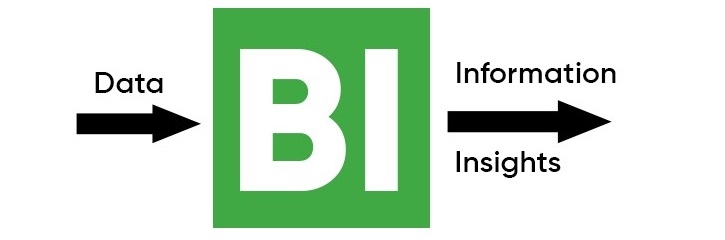
Now, inside this black box, we have business strategies, infrastructure, technologies, tools, applications, best practices, and more. The initial output provides a quick overview of the business and should spark ideas or questions. From there, you can dig deeper to get more detailed information.
This is an iterative process. After a few rounds of exploring and analyzing, you get insights that help you make better decisions to improve your business. If the first output doesnt lead to new ideas or questions, it might mean either you already know whats being shown or there could be an issue with the BI setup.
Stages of Business Intelligence
The stages of business intelligence are −
- Data Collection − We start by gathering data from various sources, like databases, spreadsheets, and online feeds.
- Data Integration − We then bring this data together into a central system, like a data warehouse or data lakehouse, so its easier to manage and analyze.
- Data Analysis − With BI tools, we analyze the combined data to uncover trends, patterns, and insights. This can involve complex calculations and making predictions about the future.
- Data Visualization − We present these insights through visual tools like charts, graphs, and dashboards, which help us easily understand and interpret the data.
- Decision-Making − We develop actionable insights based on the analysis and visualizations. This might involve improving processes, changing marketing strategies, addressing supply chain issues, or enhancing customer experiences.
Importance of Business Intelligence
Business Intelligence is an ever-growing phenomenon, and it has some important features. Some of these features are listed below −
- Enhanced Decision-Making − You can use BI to make data-driven decisions, leading to better business outcomes.
- Improved Efficiency − Integrating BI into your processes can streamline operations and reduce inefficiencies.
- Competitive Advantage − We can use BI to gain insights that help us stay ahead of the competition.
- Data-Driven Culture − BI promotes a culture where decisions are based on facts and data, not just intuition.
Challenges to Business Intelligence
Although the usage of business intelligence is required everywhere, it also poses some challenges to existing systems. Some of these challenges are listed as follows −
- Data Quality Issues − You need to ensure that the data is clean and accurate, or BI insights might be misleading.
- Complex Implementation − It requires careful planning and expertise to set up BI systems effectively.
- High Costs − We can expect significant investment in technology and training, which might be a challenge for some businesses.
- User Adoption − Initial training stages and support is needed to make sure everyone in the organization is comfortable using BI tools.
Applications of Business Intelligence
Here are several key applications of BI across various domains −
1. Enhancing Employee Engagement and Performance
Business Intelligence (BI) helps manage remote employees by tracking attendance and work setups, ensuring they have the tools and information needed for effective remote work, which supports smooth operations and employee well-being.
2. Real-time Data Availability
Business Intelligence (BI) enables immediate access to current data, helping companies monitor and respond to changes quickly, which is crucial for effective decision-making and maintaining smooth operations.
3. Data-driven Future Planning
Utilizing trends from tracking, predictive analytics, and artificial intelligence helps businesses make informed decisions about future operations. This reduces the risk of costly mistakes and provides a competitive edge by ensuring decisions are based on solid research.
Companies using Business Intelligence Strategies
The following section provides a list of top companies that use BI strategies in real life −
1. Tesla
The automotive company uses BI to wirelessly connect their cars to corporate offices, allowing them to gather and analyze data. This keeps them in touch with customers and helps fix issues like component damage or traffic hazards before they become problems.
By monitoring vehicles in real-time, they can predict maintenance needs and offer personalized recommendations, making for a smoother driving experience.
2. Starbucks
Starbucks, known worldwide for its coffee, uses BI tools to analyze data from its loyalty card program and mobile app to understand what customers enjoy buying.
By tracking individual purchase habits, Starbucks predicts what customers might want next and sends personalized offers through their app and email.
Career Options in Business Intelligence
Business Intelligence experts focus on analyzing data and generating insights to drive business decisions. They can pursue various job roles as −
- Business Analyst
- Data Analyst
- Data Engineer
- SQL Server Business Intelligence
- Business Intelligence Analyst
- BI Consultant
Companies Hiring BI Experts
The following list includes the major sectors of business which hire BI experts, along with the corresponding companies in each sector −
- Tech Companies − Google, Amazon, Microsoft
- Financial Institutions − JPMorgan Chase, Goldman Sachs
- Healthcare Organizations − UnitedHealth Group, CVS Health
- Retail Leaders − almart, Target
- Consulting Firms − Deloitte, Accenture
- Telecom Companies − AT&T, Verizon
- Manufacturing Firms − General Electric, Siemens
- E-commerce − Shopify, eBay
Prerequisite to Learn Business Intelligence
Although this is a beginner's tutorial, we assume that readers have a basic understanding of business environments and a general knowledge of concepts such as data sources, data collection, analysis, and visualization techniques.
FAQs on Business Intelligence
There are some very Frequently Asked Questions (FAQs) on Business Intelligence, this section tries to answer them briefly.
If your sales, marketing, and finance teams are struggling for detailed analytics or missing key decisions because of insufficient data, its a sign that you need a BI system.
Business intelligence looks at "What are the current trends and what actions should we take?" while data science examines "Why did this trend happen and what might occur if we take this action?"
Business intelligence is designed to handle highly structured data, while data science systems are built to manage high-speed, dynamic data.
The self-service the user does not require an IT team to access and analyze the data the self-service is a data analytics approach.