
- Autonomous Vehicles - Home
- Autonomous Vehicles - Introduction
- Autonomous Vehicles - Types
- Autonomous Vehicles - Needs
- Autonomous Vehicles - Advantages
- Autonomous Vehicles - Possible Impact
- Autonomous Vehicles - Levels of Autonomy
- Autonomous Vehicles - Technology
- Autonomous Vehicles - Risks
- Autonomous Vehicles - Applications

Autonomous Vehicles Tutorial
Autonomous Vehicles are the vehicles that can perform all the driving related tasks without any human intervention. These vehicles are also known as self-driving vehicles or robo vehicles or driverless vehicles. Some popular examples of autonomous cars include Tesla model S, Audi A8, GM Cadilac CT6, etc.
Autonomous vehicles are transforming and revolutionizing the automobile and transportation industries. These vehicles can sense navigation tasks independently using a variety of sensors, cameras, and real-time data processing systems. Using these components, autonomous vehicles access road conditions, make driving decisions, and perform safe navigation tasks to move the vehicle from one location to another.
This tutorial is meant for explaining the fundamental concepts of autonomous vehicles and their potential issues and areas of applications.
What are Autonomous Vehicles?
Autonomous vehicles are modern-day vehicles that are also known as self-driving or driverless vehicles. These vehicles are designed by integrating technologies that allow them to access real-time data of the road conditions and navigate and operate without any human intervention.
Autonomous vehicles use advanced control and monitoring systems, artificial intelligence (AI) and advanced computing technologies to capture surroundings, make driving decisions, and control the vehicle operation and movements.
Key Components of Autonomous Vehicle
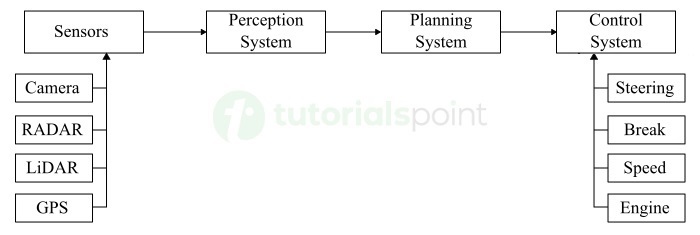
The following are the key components of the autonomous vehicle and their functions −
- Sensors − These are the devices used to capture data about surrounding conditions in real-time. They include cameras, radar, LiDAR, GPS, sonar, IMU, etc. These components act as the eyes and ears of the autonomous vehicles.
- Perception System − This system is responsible for processing raw data collected by sensors to identify and track the objects in the surrounding areas. This system can recognize other vehicles, lane markings, and road signs.
- Planning System − This system is employed for deciding vehicles actions depending on the data from the perception system. This system is crucial for ensure correct and safe movement of the vehicle.
- Control System − This system includes the control of components like steering, breaks, engine, speed, acceleration, etc. The primary function of control system is to execute actions decided by the planning system.
The block diagram of a typical autonomous vehicle or self-driving car is depicted in the following figure −
History of Autonomous Vehicle Technology
The following table highlights some of the key historical developments in the field of autonomous vehicle technology −
| Year | Description |
|---|---|
| 1948 | Ralph Teetor was invented the first ADAS (Advanced Driver Assistance System), called cruise control. |
| 1977 | First semi-autonomous car using cameras and an analog computer with a speed limit of 30 km/h was developed by Japan's Tsukuba Laboratory. |
| 1995 | First nearly (98.2% of journey) fully autonomous US coast-to-coast trip was completed by Navlab 5. |
| 1997 | The US national automated highway system represented automated driving by combining highway embedded automation with vehicle technology. |
| 2015 | Driverless cars were tested on public roads by Waymo. |
| 2018 | First commercial robo-taxi service was launched by Waymo in Phoenix, Arizona. |
| 2021 | First level 3 vehicle with limited self-driving under certain conditions was commercially introduced by Honda in Japan. |
Levels of Automation in Autonomous Vehicles
The following table gives a brief idea about automation levels used in autonomous vehicles or self-driving cars −
| SAE Level | Name | Description |
|---|---|---|
| 0 | No automation | These vehicles are fully operated by the driver in all aspects. |
| 1 | Driver assistance | Provides a driving mode control by an ADAS of either steering or speed. |
| 2 | Partial automation | Provides a driving mode execution feature by controlling both steering and speed. |
| 3 | Conditional automation | Driver has to respond to a request to perform the function. |
| 4 | High automation | If driver does not respond to a request, the car will stop safely. |
| 5 | Full automation | Automation system will control the vehicle in all aspects under all conditions. |
Role of AI in Autonomous Vehicles
Artificial Intelligence (AI) plays an important role in the development and operation of autonomous vehicles. AI enables the autonomous vehicles to understand and interpret their surroundings, so that they can make driving decision and navigate safely without need for any driver intervention.
AI in autonomous vehicles is primarily responsible for interpreting raw data from sensors like camera, radar, LiDAR, GPS, etc. and generates instructions for the planning system to make safe driving decisions.
Autonomous Vehicles Major Challenges
We have listed here some of the major challenges associated with the development, operation, and use of autonomous vehicles −
- Need for complex software and mapping system that can provide detailed road conditions for safe navigation.
- High cost required for developing reliable autonomous vehicle technologies.
- Consumers also have trust issues that limit the adoption.
- The legal regulations about accidents due to autonomous vehicles are not clear.
- Autonomous vehicles use computing technologies which are vulnerable to hacking, data theft, and other privacy issues.
- Autonomous vehicles will affect the employment of millions of professional drivers.
- Road infrastructure also creates problems in operation of autonomous vehicles.
Autonomous Vehicles Terminology
Given below are some of the important terms and their definitions related to autonomous vehicles −
- ADAS − ADAS stands for Advanced Driver Assistance System. It is a vehicle technology that can perform functions like lane keeping assistance, automatic breaking in emergency, cruise control, etc. to make the driving safer.
- LiDAR − LiDAR stands for Light Detection and Ranging. It is a sensor technology in which LASER is used to create 3D maps of surroundings around the vehicle and recognize the obstacles.
- Levels of Autonomy − These are the levels of automation used in autonomous vehicles and are defined by SAE (Society of Automotive Engineers). These levels range from level 0 (no automation) to level 5 (full automation).
- Perception System − This system is used in autonomous vehicles to process sensors data and interpret the surrounding conditions.
- Robotaxi − It is an autonomous vehicle developed for providing driverless passenger transportation commercially in a specific geographical area.
- Edge cases − In autonomous vehicles, edge cases are defined as uncommon driving situations like unusual traffic that require advanced decision making for safe navigation.
- Autonomous Delivery Vehicles − These are the autonomous vehicles specially designed for transporting goods without driver intervention.
Outlines of This Tutorial
In this tutorial on Autonomous Vehicles, you will learn about the followings −
- Introduction to Autonomous Vehicles − In this chapter, you will learn about the definition of self-driving vehicle technology and operation of driverless cars without human intervention.
- Types of Autonomous Vehicles − This chapter will explain different types of self-driving vehicles and technologies used in them.
- Need for Autonomous Vehicles − In this chapter, you will learn about the problems that these vehicles can solve.
- Advantages of Autonomous Vehicles − In this chapter of the tutorial, you will explore the key benefits of self-driving cars, like enhanced driving assistance, better traffic control, reduced accidents, and more.
- Impact on Car Manufacturers − This chapter will highlight all the major challenges and opportunities of autonomous vehicles for car manufacturers.
- Levels of Autonomy in Driving − This chapter will provide a detailed overview of six levels of autonomy defined by SAE.
- Technology Inside Autonomous Vehicles − This chapter of the tutorial will explain various technologies and components empowering autonomous vehicles.
- Risks in Autonomous Vehicles − In this chapter, you will explore the potential risks and challenges associated with the autonomous vehicles.
- Applications of Autonomous Vehicles − This chapter will explain you the real-world applications and major areas where autonomous vehicles are useful.
Who Should Learn Autonomous Vehicles Technology?
This tutorial on Autonomous Vehicles may be used as an introductory resource for beginner students who want to make their career in the field of self-driving cars as well as a reference for practicing engineers.
The tutorial can be very helpful for the following type of readers −
- Anyone having an interest in robo-vehicles or self-driving cars.
- Anyone who wants to switch his career into the field of self-driving cars and autonomous vehicles.
- Entrepreneurs having an interest in working on advanced and cutting-edge technologies in the field of artificial intelligence and vehicles.
Prerequisites to Learn Autonomous Vehicles Technology
This tutorial on Autonomous Vehicles is written at a somewhat beginner level and is meant for those who do not have a background in vehicle technologies or mechatronics.
However, a basic understanding of concepts like traditional vehicles, sensors, engines, artificial intelligence, decision-making algorithms, GPS, basic programming skills, etc. will be beneficial for easy grasping of the concepts explained in this tutorial.
FAQs on Autonomous Vehicles
In this section, we have collected some of the most Frequently Asked Questions (FAQs) on Autonomous Vehicles followed by their answers.
As of mid-2024, there is no fully autonomous vehicle (as per SAE level 5) available commercially. However, there are some partially autonomous vehicles available to use on public roads.
The primary aim of autonomous vehicles is to make driving safer, more comfortable, and enhance the driving experience. These vehicles are also supposed to contribute in reducing traffic levels, fuel consumption, and emissions.
In a vehicle, an autonomous system is nothing but a combination of sensors, data processors, and software that make a car self-driving without need for a human intervention.
As per data and reports, it is found that the driverless cars are relatively safer than cars operated by human drivers in most of the accident scenarios.
The first autonomous vehicle (self-driving car) was developed by Norman Bel Geddes in the year of 1939. This was an electric vehicle controlled and navigated by radio-controlled electromagnetic field produced by magnetized metallic nails embedded in the roads.
Yes, driverless cars can be hacked because they use computing technologies for their operation. Mainly, a driverless car is hacked through its LiDAR system that is responsible for recognizing and avoiding obstacles in the roadway.
Autonomous vehicles can be expected to have a great adoption in future for transportation, this is because of the following key reasons −
- Reduced accidents
- Reduced pollution and emissions
- Easy and better access to mobility
- Enhanced resource and asset utilization
- Automated transportation facilities, etc.
The following are the two key benefits of the autonomous vehicles −
- Reduced road accidents and enhanced safety
- Reduced traffic congestion, fuel consumption, and emissions
Autonomous vehicles have the following major disadvantages −
- Technical errors can cause malfunctioning of car and accidents
- Cyber threats and hacking like problems
- Reduce employment of professional drivers
- Need accurate and high-quality mapping system for safe navigation
- Drivers can lose their skills over time
The biggest challenge in autonomous vehicles is the safety and reliability concerns. These are mainly due to incorrect interpretation of vehicles surroundings.