
- NovelAI - Home
- NovelAI - Getting Started
- NovelAI - Editor
- NovelAI - User Settings
- NovelAI - Lorebook
- NovelAI - Text Adventure
- NovelAI - Module Training
- NovelAI - Models
- NovelAI - Image Generation
- NovelAI Useful Resources
- NovelAI - Quick Guide
- NovelAI - Useful Resources
- NovelAI - Discussion
NovelAI Tutorial
What is NovelAI?
NovelAI is a cloud based AI storytelling tool and text-to-image generator that is created and owned by Anlatan. It is the latest innovation in AI that helps you to construct unique stories and illustrations. It helps to bring your imagination into real life.
NovelAI is a monthly subscription service for AI-assisted image generation, storytelling, or simply a Large Language Model(LLM) that brings imagination to reality.
If you are someone who loves creating stories but has a writer's block. This Artificial Intelligence (AI) tool might help you.
NovelAI History
NovelAI is developed by Anlatan, a team dedicated to enhancing the creative process through AI. Anlatan focuses on crafting tools that align with the needs of storytellers. It officially launched NovelAI on April 28, 2021.
In April 2023, Anlatan added ControlNet features to their text-to-image NovelAI Diffusion model. The tool runs on a back end powered by CoreWeave, which is a specialized cloud infrastructure that makes sure that the platform can handle large volumes of data. This helps in the faster generation of stories and images.
NovelAI Features
NovelAI is a versatile AI tool designed exclusively to assist with storytelling and image generation. Some of its key features are −
- Focus on Storytelling − Unlike other generative AI tools like ChatGPT, this is developed exclusively for creating stories and visuals.
- Diverse AI Models − It is a combination of several models like Calliope, Sigurd, Enterpe, Krake, and Genji.
- Custom AI Modules − The platform consists of additional features like Text Adventure to enhance your writing.
- Image Generation − NovelAI can generate images, particularly in the anime-art style.
- Privacy and Security − All the stories that are generated by the user are encrypted with XSalsa20, which can only be accessed by the user.
- Lorebook − Create, organize, and maintain your stories and characters based on the prompted scenarios.
- Memory Capacity − The tool offers up to 8192 tokens of memory, which helps the continuity of the story seamlessly.
Getting Started With NovelAI
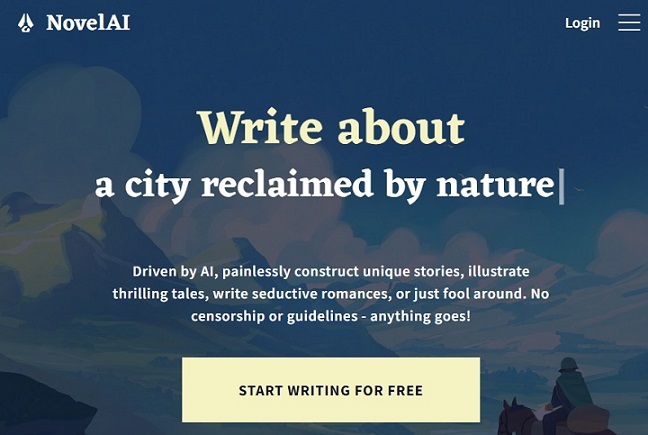
The best way to get started is to visit the official website, where you would find the "Start writing for free" button to create a new story. Apart from just trying it out, if you want to save your work, you'll need to create an account.
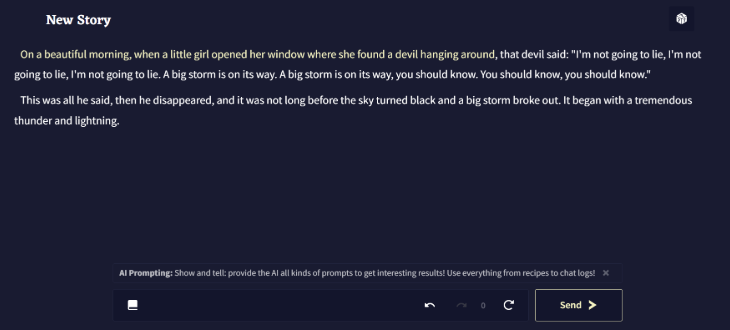
After you opt for the free trial, it will open a console where you can enter your prompt. For example, for the prompt "On a beautiful morning, when a little girl opened her window, she found a devil hanging around." It would start narrating the rest of the part as given in the image below −
The free version offers limited access with around 6,144 tokens of memory, i.e., 24,500 characters. To access the complete features of the platform, you should subscribe to their plans.
Pricing Options
There are a few subscription plans that the platform offers in case you decide to sign up. Though all the plans include unlimited data generation, the pricing varies based on the amount of memory tokens and Anlas (currency for custom AI module training and image generation) you receive each month. Below are subscription plans offered −
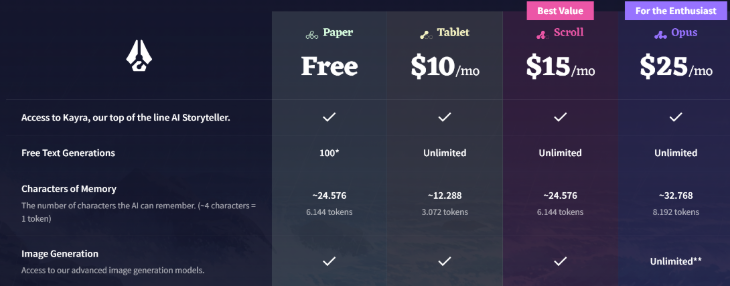
Select the subscription plan based on the individual's requirements. While Opus grants access to advanced features, Tablet and Scroll might satisfy minimal needs with basic functionality. Below is the detailed description of each plan −
- Tablet − This plan provides access to Kayra, the top storytelling model. It provides memory of up to 3072 tokens, i.e., 12,888 characters. Grants access to advanced image generation models and provides 1,000 Anlas.
- Scroll − This plan also provides access to Kayra, the top storytelling model. It provides memory of up to 6144 tokens, i.e., 24,576 characters. Grants access to advanced image generation models and also provides 1,000 Anlas.
- Opus − This plan also provides access to Kayra, the top storytelling model. It provides memory of up to 8192 tokens, i.e., 32,768 characters. Grants access to unlimited image generation and provides 10,000 Anlas.
Exploring NovelAI Platform
When you first log in to the platform, you will be directed to a dashboard where you can choose either Storyteller or Text Adventure. Additionally, you will find an option called Scenarios to explore prompts from other authors. The features offered are discussed below −
- Storyteller Mode − In this mode, once you start writing, the AI storytelling chatbots like Kayra and Clio contribute to the story. The chatbot also mimics certain authors' writing styles.
- Text Adventure − This mode is much similar to role playing, where you provide a situation or scenario to create a story. As the story progresses, you will be given options that will change the narrative and tone of the story.
- Scenarios − Scenarios are writing prompts from other authors, which help the user with ideas. Once you choose "View all scenarios," you will be navigated to a screen where you can scroll through various options; you can also browse based on keywords like author and genre.
Use Cases of NovelAI
The main goal of the NovelAI platform is storytelling and writing, so the diverse applications involve users who look to enhance the storytelling process like −
- Budding Writers − Someone who is new to the field of writing can use the AI assistant to get ideas and refine their narratives.
- Authors − The AI assistant can also be helpful to experienced writers to break through writer's block by diving into different themes and narratives.
- Visual Artists − The tool also helps users pair visualization of characters with the narrative.
- Students − NovelAI can be used by students to explore creative writing and literature comprehension.
Tips to Enhance Your Writing Style
Platforms like NovelAI provide great assistance in getting started with storytelling and fine-tuning details. If you are a beginner, start by developing a character and outline elements so that the machine learning algorithms understand your preferences. Additionally, the more you use NovelAI, the more the algorithms will match your writing style.
Before getting deeper into the story, consider providing the plot, descriptions of the main characters, and a little synopsis of the story setting. You can also use features provided by the platform like "retry", "flatten story", and "trim story" to refine and edit your story.
FAQs on NovelAI
In this section, we have collected a set of Frequently Asked Questions on NovelAI followed by their answers −
NovelAI is an AI storytelling tool that can be accessed by anyone to create and build stories. It doesn't require learning any programming language and has a user-friendly interface.
Though both of them are advanced text generation tools, the difference lies in the purpose they serve. While NovelAI is exclusively developed with features to tailor narrative generation and character development, ChatGPT is more like a conversational AI that handles various topics and queries, focusing more on sharing information to the user's prompt.
NovelAI is a subscription-based model, but you can access it using a limited free trial. But for the full functionality, you have to subscribe.
NovelAI can generate stories in multiple languages, including English and Japanese. For the best results in story generation and creative writing, English is recommended.
While NovelAI has its own benefits and features, it also has certain limitations like creativity constraints, as it cannot resemble with human creativity. Additionally, there might be ambiguity in understanding the prompt and the content generated requires human editing and refinement.